You’ve framed your study. You’ve built your review.
Now it’s time to design what comes next.
The Design: Design Your Study with Purpose, Precision, and Proof is a guided workbook for crafting Chapter 3 (Methodology) with clarity, logic, and confidence. Chapter 3 is more than a checklist of steps—it’s the blueprint that shows your committee (and future readers) exactly how you will do the work, ethically and credibly.
Whether you’re using interviews or surveys, narrative or regression, this workbook helps ensure your design doesn’t just follow a formula—it reflects the soul of your study. And yes… it’s more granular than the others in the series (because Chapter 3 requires it), but it will pay off.
Created by Dr. Rahmatu “Dr. K.” Kassimu (educator, public health strategist, and academic writing coach), The Design walks you through choosing, building, explaining, and defending your research plan—one aligned decision at a time.
What’s Inside
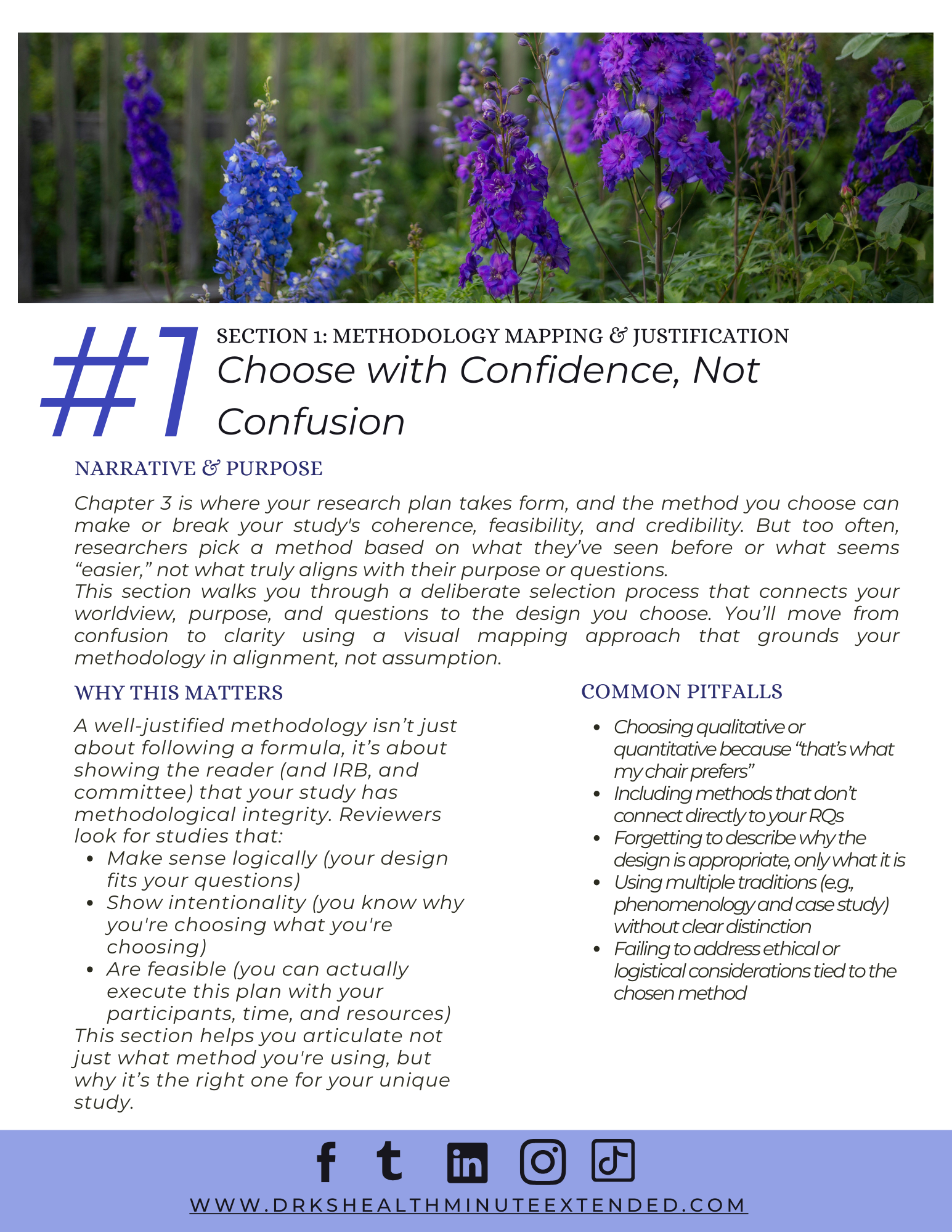
Section 1: Methodology Mapping & Justification (Choose with Confidence, Not Confusion)
Stop picking methods based on what looks “easier” or what someone else prefers. You’ll learn to connect your worldview, purpose, and research questions to a defensible methodology and design.
Includes tools like:
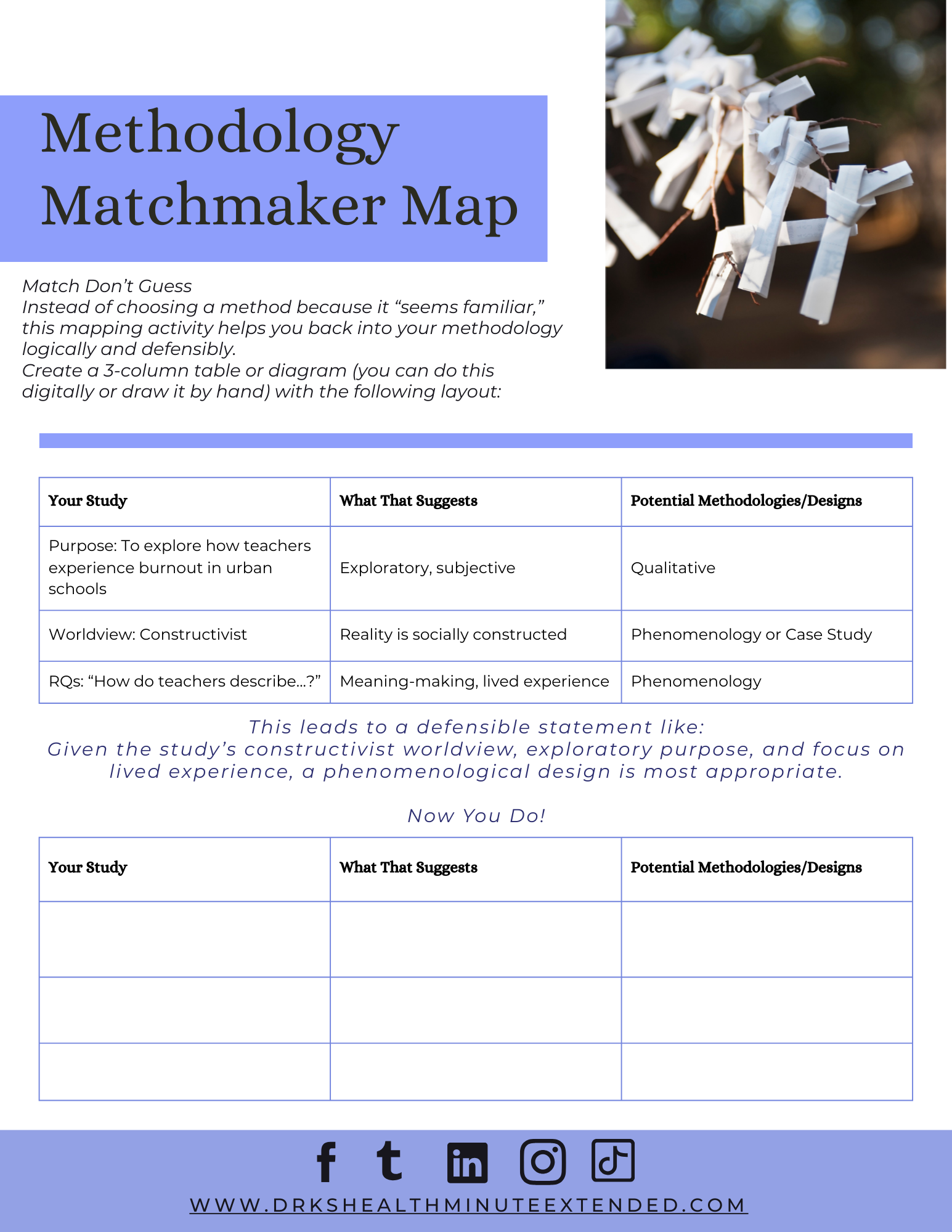
Methodology Matchmaker Map (match—don’t guess)
Design Decoder Table (head-to-head design comparisons: case study vs. phenomenology vs. experimental, etc.)
Method Match Justification Builder (purpose → data needed → methodology → design rationale → RQ alignment)
Checklists to avoid common Chapter 3 pitfalls (misalignment, vague rationale, mixing traditions without clarity)
Section 2: Blueprinting the Study (Designing Your Core Blocks)
This is where alignment becomes logistics. You’ll map the “who, what, where, and how” in a way that’s replicable, transparent, and ethically grounded—not vague and hopeful.
Includes:
Design-in-Action Planner (participants, sampling, setting, tools, procedures, analysis strategy)
Participant Profile Builder (population, sample, size justification, inclusion/exclusion, recruitment plan)
Data Collection Matrix (tie each research question to data source, instrument, procedure, and ethical considerations)
Analysis Preview Worksheet (outline your analysis flow and safeguards)
IRB Readiness Prompt List (anticipate ethical questions before they’re asked)
Section 3: Write with Rationale (From Abstract to Clear and Defensible)
Planning is one thing. Writing Chapter 3 so it sounds confident (not generic or defensive) is another. This section helps you transform your blueprint into strong rationale paragraphs.
Includes:
Rationale Sentence Starters (so every “what” has a “why”)
From Bullet to Paragraph worksheet (notes → sentences → polished paragraph)
Vague vs. Aligned Rewrite practice (because committees spot vague instantly)
Anticipating Limitations & Safeguards (acknowledge limits without sounding uncertain)
Section 4: Audit & Adapt (From Drafted to Defensible)
You’ll step back and assess your Chapter 3 as a coherent system—checking logic, feasibility, and alignment before your committee does.
Includes:
Whole-Chapter Reverse Outline (see what your chapter actually does on the page)
Feasibility Check (timeline, access, tools, personal capacity—realistic, not optimistic)
Alignment Audit Checklist (design → participants → tools → analysis → ethics)
This Workbook Is Perfect For…
Doctoral and thesis writers drafting or revising Chapter 3 (Methodology)
Students getting “needs more detail” or “unclear alignment” feedback
Researchers who want a design that’s doable, ethical, and defensible
Writers preparing for proposal defense or IRB and needing their plan tight and transparent
You’ll Walk Away With…
By the end of The Design, you will have:
A clearly chosen and justified methodology + design aligned to your purpose and research questions
A complete blueprint for participants, recruitment, instruments, procedures, analysis, and ethics
Rationale language that explains your choices with clarity and authority
A Chapter 3 that reads as intentional, credible, and ready to defend
You’ve framed your study. You’ve built your review.
Now it’s time to design what comes next.
The Design: Design Your Study with Purpose, Precision, and Proof is a guided workbook for crafting Chapter 3 (Methodology) with clarity, logic, and confidence. Chapter 3 is more than a checklist of steps—it’s the blueprint that shows your committee (and future readers) exactly how you will do the work, ethically and credibly.
Whether you’re using interviews or surveys, narrative or regression, this workbook helps ensure your design doesn’t just follow a formula—it reflects the soul of your study. And yes… it’s more granular than the others in the series (because Chapter 3 requires it), but it will pay off.
Created by Dr. Rahmatu “Dr. K.” Kassimu (educator, public health strategist, and academic writing coach), The Design walks you through choosing, building, explaining, and defending your research plan—one aligned decision at a time.
What’s Inside
Section 1: Methodology Mapping & Justification (Choose with Confidence, Not Confusion)
Stop picking methods based on what looks “easier” or what someone else prefers. You’ll learn to connect your worldview, purpose, and research questions to a defensible methodology and design.
Includes tools like:
Methodology Matchmaker Map (match—don’t guess)
Design Decoder Table (head-to-head design comparisons: case study vs. phenomenology vs. experimental, etc.)
Method Match Justification Builder (purpose → data needed → methodology → design rationale → RQ alignment)
Checklists to avoid common Chapter 3 pitfalls (misalignment, vague rationale, mixing traditions without clarity)
Section 2: Blueprinting the Study (Designing Your Core Blocks)
This is where alignment becomes logistics. You’ll map the “who, what, where, and how” in a way that’s replicable, transparent, and ethically grounded—not vague and hopeful.
Includes:
Design-in-Action Planner (participants, sampling, setting, tools, procedures, analysis strategy)
Participant Profile Builder (population, sample, size justification, inclusion/exclusion, recruitment plan)
Data Collection Matrix (tie each research question to data source, instrument, procedure, and ethical considerations)
Analysis Preview Worksheet (outline your analysis flow and safeguards)
IRB Readiness Prompt List (anticipate ethical questions before they’re asked)
Section 3: Write with Rationale (From Abstract to Clear and Defensible)
Planning is one thing. Writing Chapter 3 so it sounds confident (not generic or defensive) is another. This section helps you transform your blueprint into strong rationale paragraphs.
Includes:
Rationale Sentence Starters (so every “what” has a “why”)
From Bullet to Paragraph worksheet (notes → sentences → polished paragraph)
Vague vs. Aligned Rewrite practice (because committees spot vague instantly)
Anticipating Limitations & Safeguards (acknowledge limits without sounding uncertain)
Section 4: Audit & Adapt (From Drafted to Defensible)
You’ll step back and assess your Chapter 3 as a coherent system—checking logic, feasibility, and alignment before your committee does.
Includes:
Whole-Chapter Reverse Outline (see what your chapter actually does on the page)
Feasibility Check (timeline, access, tools, personal capacity—realistic, not optimistic)
Alignment Audit Checklist (design → participants → tools → analysis → ethics)
This Workbook Is Perfect For…
Doctoral and thesis writers drafting or revising Chapter 3 (Methodology)
Students getting “needs more detail” or “unclear alignment” feedback
Researchers who want a design that’s doable, ethical, and defensible
Writers preparing for proposal defense or IRB and needing their plan tight and transparent
You’ll Walk Away With…
By the end of The Design, you will have:
A clearly chosen and justified methodology + design aligned to your purpose and research questions
A complete blueprint for participants, recruitment, instruments, procedures, analysis, and ethics
Rationale language that explains your choices with clarity and authority
A Chapter 3 that reads as intentional, credible, and ready to defend