Your literature review isn’t just a list of sources.
It’s a frame.
It holds the structure of your study.
It shows how your work is informed by—and in conversation with—what’s come before.
And it gives readers a clear sense of the intellectual blueprint you’re building from.
That’s a lot of pressure… and it’s exactly why so many people get stuck.
The Frame: Chapter 2 – Literature Review with Vision and Voice is a digital workbook designed to move you from overwhelmed reader to intentional researcher. Instead of drowning in PDFs, you’ll learn how to define what belongs in your review, search with strategy, and organize your ideas into meaningful themes that lead directly to your study.
Created by Dr. Rahmatu “Dr. K.” Kassimu, this workbook walks you through the quiet, crucial decisions that make Chapter 2 doable, aligned, and compelling.
What’s Inside
The Frame is built around four core moves:
1. Clarify Your Scope: What Am I Actually Reviewing?
Most literature reviews fall apart before a single paragraph is written—because the scope was never clear. This section helps you tighten your focus without losing your passion.
You’ll work through:
A “What Belongs in My Review?” scope guide to define your boundaries and stay out of the “summarize everything ever written” trap.
A Topic-to-Term Brainstorm Map to turn a broad idea into clear concepts, keywords, and related terms.
Reflection prompts to identify:
What’s central vs. merely interesting
Which populations, contexts, and timeframes you’re prioritizing
How your review will directly support your problem, purpose, and research questions
Call-out boxes on common pitfalls like:
Scope creep (including too much)
Concept clutter (too many frameworks/terms at once)
Search paralysis (no plan, just vibes and Google Scholar)
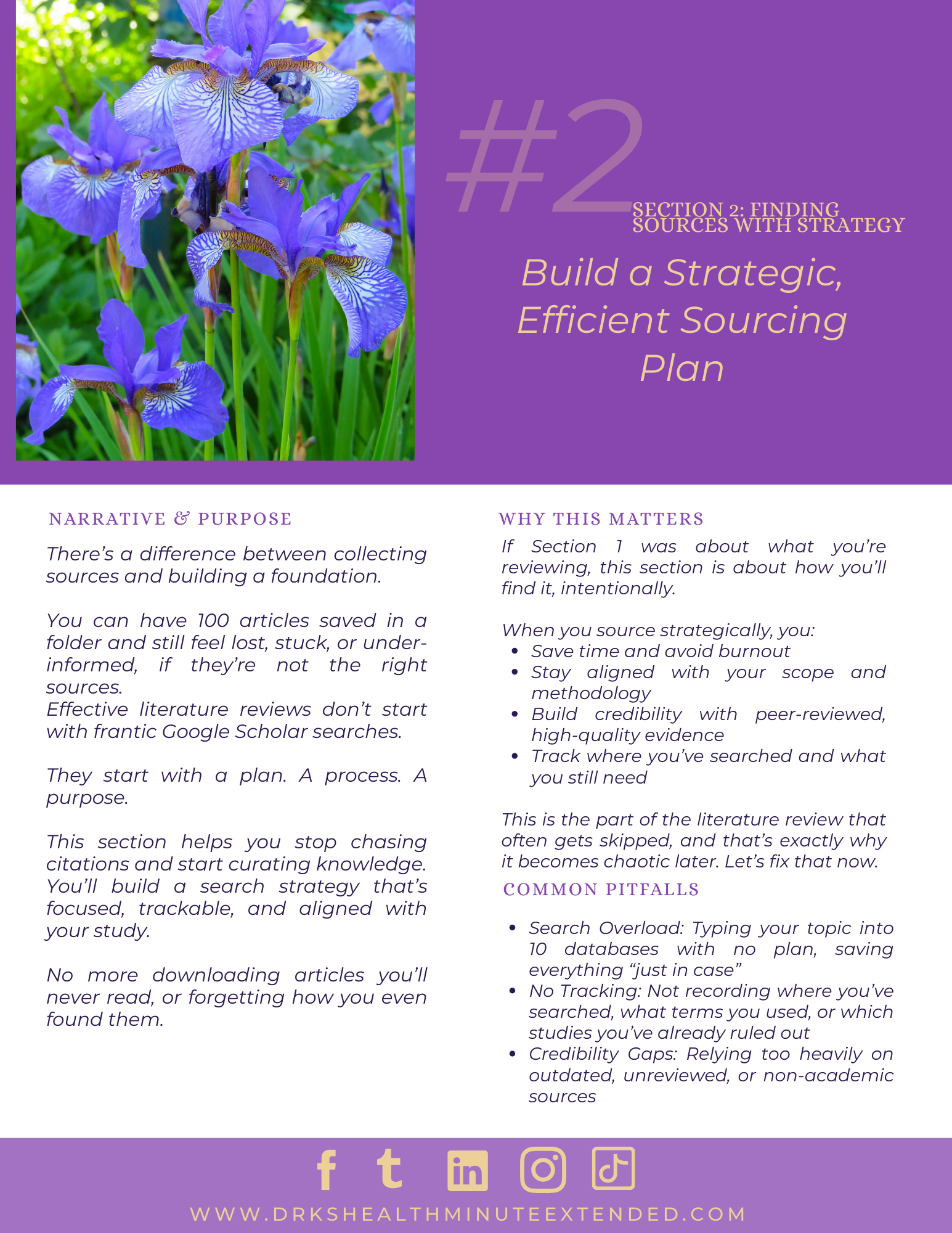
2. Build a Strategic Search & Sourcing Plan
You don’t need more articles—you need the right articles.
In this section, you’ll stop randomly clicking and start sourcing with intention:
A Search Strategy Planner to decide:
A Keyword & Boolean Builder that breaks your topic into conceptual clusters and helps you build strong search strings (AND/OR/NOT) instead of guessing.
A Credibility & Relevance Flowchart to decide:
Is this source peer-reviewed and credible?
Is it current enough for my field?
Does it actually move my study forward—or is it just “interesting”?
A Search Log template so you can track what you searched, where, and what you found (and stop redoing the same search at 2 a.m.).
3. Map Themes, Gaps, and Connections
Once you start collecting sources, the real work is making sense of them.
This section helps you move from scattered notes to a clear, thematic picture:
A Literature Matrix to capture:
A Thematic Sorting Activity that walks you through grouping studies into 3–5 themes (without overthinking the labels).
Prompts to summarize each theme:
What are these studies collectively saying?
Where do they agree or diverge?
How does this theme connect to my proposed study?
A Gap/Need for Your Study builder to help you articulate:
4. Start Shifting from Summary to Synthesis (and Voice)
You don’t have to write full paragraphs yet—but you do start practicing the habits that make Chapter 2 strong.
This section includes:
Note-taking scaffolds that push you past “Smith (2021) said…” into:
Sentence stems that model synthesis language (connecting, contrasting, and integrating sources).
Reflection questions to begin exploring your academic voice—how you want this review to sound: clear, grounded, and confident, not stiff or performative.
(When you’re ready to write and polish full paragraphs, The Build picks up where The Frame leaves off.)
This Workbook Is Perfect For…
Doctoral and thesis writers who feel buried under articles and don’t know where to start.
Students who’ve been told “your topic is too broad” or “your review isn’t focused enough.”
Practitioners-turned-scholars who have rich experience but need help turning that into a targeted literature review.
Anyone preparing to use The Build and wanting a solid foundation of scope, sources, and themes before drafting Chapter 2.
You’ll Walk Away With…
By the end of The Frame, you will have:
A clear scope for your literature review—what’s in, what’s out, and why.
A strategic search plan and a record of where you’ve already looked.
A curated working list of credible, relevant sources that actually support your study.
A structured literature matrix and 3–5 emerging themes connected to your problem and purpose.
A first-pass articulation of the gap/need for your study in the literature.
The beginnings of your researcher voice and synthesis habits that will make Chapter 2 easier to write.
Your literature review isn’t just a list of sources.
It’s a frame.
It holds the structure of your study.
It shows how your work is informed by—and in conversation with—what’s come before.
And it gives readers a clear sense of the intellectual blueprint you’re building from.
That’s a lot of pressure… and it’s exactly why so many people get stuck.
The Frame: Chapter 2 – Literature Review with Vision and Voice is a digital workbook designed to move you from overwhelmed reader to intentional researcher. Instead of drowning in PDFs, you’ll learn how to define what belongs in your review, search with strategy, and organize your ideas into meaningful themes that lead directly to your study.
Created by Dr. Rahmatu “Dr. K.” Kassimu, this workbook walks you through the quiet, crucial decisions that make Chapter 2 doable, aligned, and compelling.
What’s Inside
The Frame is built around four core moves:
1. Clarify Your Scope: What Am I Actually Reviewing?
Most literature reviews fall apart before a single paragraph is written—because the scope was never clear. This section helps you tighten your focus without losing your passion.
You’ll work through:
A “What Belongs in My Review?” scope guide to define your boundaries and stay out of the “summarize everything ever written” trap.
A Topic-to-Term Brainstorm Map to turn a broad idea into clear concepts, keywords, and related terms.
Reflection prompts to identify:
What’s central vs. merely interesting
Which populations, contexts, and timeframes you’re prioritizing
How your review will directly support your problem, purpose, and research questions
Call-out boxes on common pitfalls like:
Scope creep (including too much)
Concept clutter (too many frameworks/terms at once)
Search paralysis (no plan, just vibes and Google Scholar)
2. Build a Strategic Search & Sourcing Plan
You don’t need more articles—you need the right articles.
In this section, you’ll stop randomly clicking and start sourcing with intention:
A Search Strategy Planner to decide:
A Keyword & Boolean Builder that breaks your topic into conceptual clusters and helps you build strong search strings (AND/OR/NOT) instead of guessing.
A Credibility & Relevance Flowchart to decide:
Is this source peer-reviewed and credible?
Is it current enough for my field?
Does it actually move my study forward—or is it just “interesting”?
A Search Log template so you can track what you searched, where, and what you found (and stop redoing the same search at 2 a.m.).
3. Map Themes, Gaps, and Connections
Once you start collecting sources, the real work is making sense of them.
This section helps you move from scattered notes to a clear, thematic picture:
A Literature Matrix to capture:
A Thematic Sorting Activity that walks you through grouping studies into 3–5 themes (without overthinking the labels).
Prompts to summarize each theme:
What are these studies collectively saying?
Where do they agree or diverge?
How does this theme connect to my proposed study?
A Gap/Need for Your Study builder to help you articulate:
4. Start Shifting from Summary to Synthesis (and Voice)
You don’t have to write full paragraphs yet—but you do start practicing the habits that make Chapter 2 strong.
This section includes:
Note-taking scaffolds that push you past “Smith (2021) said…” into:
Sentence stems that model synthesis language (connecting, contrasting, and integrating sources).
Reflection questions to begin exploring your academic voice—how you want this review to sound: clear, grounded, and confident, not stiff or performative.
(When you’re ready to write and polish full paragraphs, The Build picks up where The Frame leaves off.)
This Workbook Is Perfect For…
Doctoral and thesis writers who feel buried under articles and don’t know where to start.
Students who’ve been told “your topic is too broad” or “your review isn’t focused enough.”
Practitioners-turned-scholars who have rich experience but need help turning that into a targeted literature review.
Anyone preparing to use The Build and wanting a solid foundation of scope, sources, and themes before drafting Chapter 2.
You’ll Walk Away With…
By the end of The Frame, you will have:
A clear scope for your literature review—what’s in, what’s out, and why.
A strategic search plan and a record of where you’ve already looked.
A curated working list of credible, relevant sources that actually support your study.
A structured literature matrix and 3–5 emerging themes connected to your problem and purpose.
A first-pass articulation of the gap/need for your study in the literature.
The beginnings of your researcher voice and synthesis habits that will make Chapter 2 easier to write.